

My hobby is fencing. Fencing is very interesting sport and I like it․ I like it, because it is very beautiful kind of sport. I didn’t know, but my grandma also went to fencing․ She like fencing too. I would like to advise you to join this sport and decide yourself. And now about fencing․
Fencing traces its roots to the development of swordsmanship for duels and self defense. Fencing is believed to have originated in Spain; some of the most significant books on fencing were written by Spanish fencers. Treatise on Arms was written by Diego de Valera between 1458 and 1471 and is one of the oldest surviving manuals on western fencing (in spite of the title, the book of Diego Valera was on heraldry, not about fencing) shortly before dueling came under official ban by the Catholic Monarchs. In conquest, the Spanish forces carried fencing around the world, particularly to southern Italy, one of the major areas of strife between both nations. Fencing was mentioned in the play The Merry Wives of Windsor written sometime prior to 1602.
The mechanics of modern fencing originated in the 18th century in an Italian school of fencing of the Renaissance, and under their influence, were improved by the French school of fencing. The Spanish school of fencing stagnated and was replaced by the Italian and French schools.
Development into a sport
The shift towards fencing as a sport rather than as military training happened from the mid-18th century, and was led by Domenico Angelo, who established a fencing academy, Angelo’s School of Arms, in Carlisle House, Soho, London in 1763. There, he taught the aristocracy the fashionable art of swordsmanship. His school was run by three generations of his family and dominated the art of European fencing for almost a century.

1763 fencing print from Domenico Angelo’s instruction book. Angelo was instrumental in turning fencing into an athletic sport.
He established the essential rules of posture and footwork that still govern modern sport fencing, although his attacking and parrying methods were still much different from current practice. Although he intended to prepare his students for real combat, he was the first fencing master to emphasize the health and sporting benefits of fencing more than its use as a killing art, particularly in his influential book L’École des armes (The School of Fencing), published in 1763.
Basic conventions were collated and set down during the 1880s by the French fencing master Camille Prévost. It was during this time that many officially recognised fencing associations began to appear in different parts of the world, such as the Amateur Fencers League of America was founded in 1891, the Amateur Fencing Association of Great Britain in 1902, and the Fédération Nationale des Sociétés d’Escrime et Salles d’Armes de France in 1906.
The first regularized fencing competition was held at the inaugural Grand Military Tournament and Assault at Arms in 1880, held at the Royal Agricultural Hall, in Islington in June. The Tournament featured a series of competitions between army officers and soldiers. Each bout was fought for five hits and the foils were pointed with black to aid the judges. The Amateur Gymnastic & Fencing Association drew up an official set of fencing regulations in 1896.
Fencing was part of the Olympic Games in the summer of 1896. Sabre events have been held at every Summer Olympics; foil events have been held at every Summer Olympics except 1908; épée events have been held at every Summer Olympics except in the summer of 1896 because of unknown reasons.
Starting with épée in 1933, side judges were replaced by the Laurent-Pagan electrical scoring apparatus, with an audible tone and a red or green light indicating when a touch landed. Foil was automated in 1956, sabre in 1988. The scoring box reduced the bias in judging, and permitted more accurate scoring of faster actions, lighter touches, and more touches to the back and flank than before.
Equipment
Weapons
There are three weapons in modern fencing: foil, épée, and sabre. Each weapon has its own rules and strategies. Equipment needed includes at least 2 swords, a Lame (not for épée), a white jacket, underarm protector, two body and mask cords, knee high socks, glove and knickers.
Foil

Valid foil targets
The foil is a light thrusting weapon with a maximum weight of 500 grams. The foil targets the torso, but not the arms or legs. The foil has a small circular hand guard that serves to protect the hand from direct stabs. As the hand is not a valid target in foil, this is primarily for safety. Touches are scored only with the tip; hits with the side of the blade do not register on the electronic scoring apparatus (and do not halt the action). Touches that land outside the target area (called an off-target touch and signaled by a distinct color on the scoring apparatus) stop the action, but are not scored. Only a single touch can be awarded to either fencer at the end of a phrase. If both fencers land touches within a close enough interval of milliseconds to register two lights on the machine, the referee uses the rules of «right of way» to determine which fencer is awarded the touch, or if an off-target hit has priority over a valid hit, in which case no touch is awarded. If the referee is unable to determine which fencer has right of way, no touch is awarded.
Épée

Valid épée targets
The épée is a thrusting weapon like the foil, but heavier, with a maximum total weight of 775 grams. In épée, the entire body is valid target. The hand guard on the épée is a large circle that extends towards the pommel, effectively covering the hand, which is a valid target in épée. Like foil, all hits must be with the tip and not the sides of the blade. Hits with the side of the blade do not register on the electronic scoring apparatus (and do not halt the action). As the entire body is legal target, there is no concept of an off-target touch, except if the fencer accidentally strikes the floor, setting off the light and tone on the scoring apparatus. Unlike foil and sabre, épée does not use «right of way», and awards simultaneous touches to both fencers. However, if the score is tied in a match at the last point and a double touch is scored, the point is null and void.
Sabre

Valid sabre targets
The sabre is a light cutting and thrusting weapon that targets the entire body above the waist, except the weapon hand. Sabre is the newest weapon to be used. Like the foil, the maximum legal weight of a sabre is 500 grams. The hand guard on the sabre extends from hilt to the point at which the blade connects to the pommel. This guard is generally turned outwards during sport to protect the sword arm from touches. Hits with the entire blade or point are valid. As in foil, touches that land outside the target area are not scored. However, unlike foil, these off-target touches do not stop the action, and the fencing continues. In the case of both fencers landing a scoring touch, the referee determines which fencer receives the point for the action, again through the use of «right of way».
Protective clothing
Most personal protective equipment for fencing is made of tough cotton or nylon. Kevlar was added to top level uniform pieces (jacket, breeches, underarm protector, lamé, and the bib of the mask) following the death of Vladimir Smirnov at the 1982 World Championships in Rome. However, Kevlar is degraded by both ultraviolet lightand chlorine, which can complicate cleaning.
Other ballistic fabrics, such as Dyneema, have been developed that resist puncture, and which do not degrade the way that Kevlar does. FIE rules state that tournament wear must be made of fabric that resists a force of 800 newtons (180 lbf), and that the mask bib must resist twice that amount.
The complete fencing kit includes:
- Jacket
- The jacket is form-fitting, and has a strap (croissard) that passes between the legs. In sabre fencing, jackets are cut along the waist.[clarification needed] A small gorgetof folded fabric is sewn in around the collar to prevent an opponent’s blade from slipping under the mask and along the jacket upwards towards the neck. Fencing instructors may wear a heavier jacket, such as one reinforced by plastic foam, to deflect the frequent hits an instructor endures.
- Plastron
- A plastron is an underarm protector worn underneath the jacket. It provides double protection on the side of the sword arm and upper arm. There is no seam under the arm, which would line up with the jacket seam and provide a weak spot.
- Glove
- The sword hand is protected by a glove with a gauntlet that prevents blades from going up the sleeve and causing injury. The glove also improves grip.
- Breeches
- Breeches or knickers are short trousers that end just below the knee. The breeches are required to have 10 cm of overlap with the jacket. Most are equipped with suspenders (braces).
- Socks
- Fencing socks are long enough to cover the knee; some cover most of the thigh.
- Shoes
- Fencing shoes have flat soles, and are reinforced on the inside for the back foot, and in the heel for the front foot. The reinforcement prevents wear from lunging.
- Mask
- The fencing mask has a bib that protects the neck. The mask should support 12 kilograms (26 lb) on the metal mesh and 350 newtons (79 lbf) of penetration resistance on the bib. FIE regulations dictate that masks must withstand 25 kilograms (55 lb) on the mesh and 1,600 newtons (360 lbf) on the bib. Some modern masks have a see-through visor in the front of the mask. These have been used at high level competitions (World Championships etc.), however, they are currently banned in foil and épée by the FIE, following a 2009 incident in which a visor was pierced during the European Junior Championship competition. There are foil, sabre, and three-weapon masks.
- Chest protector
- A chest protector, made of plastic, is worn by female fencers and, sometimes, by boys. Fencing instructors also wear them, as they are hit far more often during training than their students. In foil fencing, the hard surface of a chest protector decreases the likelihood that a hit registers.
- Lamé
- A lamé is a layer of electrically conductive material worn over the fencing jacket in foil and sabre fencing. The lamé covers the entire target area, and makes it easier to determine whether a hit fell within the target area. (In épée fencing the lamé is unnecessary, since the target area spans the competitor’s entire body.) In sabre fencing, the lamé’s sleeves end in a straight line across the wrist; in foil fencing, the lamé is sleeveless. A body cord is necessary to register scoring. It attaches to the weapon and runs inside the jacket sleeve, then down the back and out to the scoring box. In sabre and foil fencing, the body cord connects to the lamé in order to create a circuit to the scoring box.
- Sleeve
- An instructor or master may wear a protective sleeve or a leg leather to protect their fencing arm or leg, respectively.
- Elements of protective clothing
-

Jacket
-
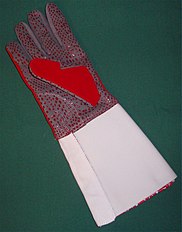
Glove
-

Sous-Plastron
-

Breeches/Knickers
-
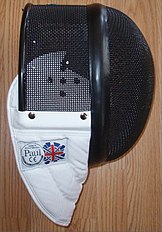
Mask
-

Chest protector for women


Traditionally, the fencer’s uniform is white, and an instructor’s uniform is black. This may be due to the occasional pre-electric practice of covering the point of the weapon in dye, soot, or colored chalk in order to make it easier for the referee to determine the placing of the touches. As this is no longer a factor in the electric era, the FIE rules have been relaxed to allow colored uniforms (save black). The guidelines also limit the permitted size and positioning of sponsorship logos.
Grips
Some pistol grips used by foil and épée fencers (main article Grip (sport fencing))
-
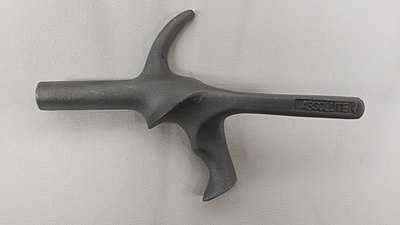
Visconti grip
-

Belgian grip
-
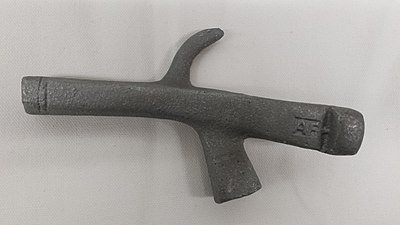
Russian grip
-
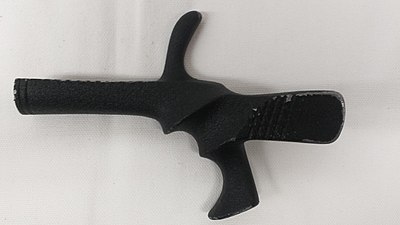
Hungarian grip


 Արփինե Խաչատրյանի բլոգ